

How to Choose a Metal Outdoor Storage Building for Farm and Home Use
If you need dependable outdoor storage for tractors, tools, trailers, lawn equipment, or workshop supplies, then a metal storage building is often the smartest long-term option. For example, the best models give you more usable space. In addition, they provide stronger structural framing. Because of this, you get better weather resistance. As a result, you also benefit from lower maintenance compared to many traditional shed materials.That matters on farms, acreages, construction sites, and large residential properties where storage needs grow over time. Source
Why Metal Storage Buildings Are Growing in Popularity
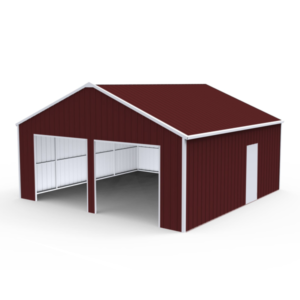
Buyers are moving toward metal storage buildings because they want something stronger than a basic backyard shed. Rural properties, farm operations, and even home workshops often need space for bulky equipment, larger doors, better weather protection, and a structure that can stand up to repeated daily use. The featured 25FT x 33FT KoreJet Metal building is marketed specifically for farm and equipment storage, garage use, and workshop use. Source
Suggested visual: bold checklist layout with icons for size, frame gauge, door access, wind rating, snow load, and foundation.
What a Metal Outdoor Storage Building Is
A metal outdoor storage building is a steel-framed structure designed to protect equipment, tools, vehicles, materials, and supplies from rain, sun, snow, and wind. Depending on the design, it can function as a garage, tractor shelter, workshop, contractor storage building, or overflow warehouse space. The KoreJet example is listed as a heavy-duty steel garage/storage shed with roughly 825 square feet of floor space shown in the product graphics. Source
Who It’s For
This type of building is a strong fit for homeowners with acreage, small farms, ranch properties, contractors, equipment owners, and businesses that need sheltered storage without building a full conventional structure.It is especially practical for storing tractors, trailers, UTVs, mowers, workbenches, repair tools, fencing supplies, and seasonal materials. For example, the product imagery for the featured building shows truck, tractor, garage, and workshop-style use. In other words, it is designed to handle a wide range of real-world storage needs.. Source
The Specs That Matter Most
1. Footprint and usable floor area
The building size tells you how much room you have on paper, but usable layout is what really matters. The featured model is listed at 25 feet by 33 feet, and one of the graphics shows 825 square feet of floor space. That can be enough for mixed storage, work zones, and equipment parking if the layout is planned well. Source
2. Steel frame strength
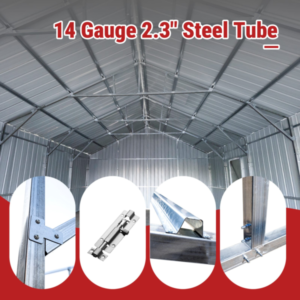
Frame quality is one of the biggest indicators of long-term performance. The KoreJet specification graphics show a 14-gauge 2.3-inch steel tube frame, which is one of the strongest visible structural details on the page. Stronger framing usually means better rigidity, better resistance to movement, and better durability under repeated use. Source
3. Door layout
A building is only as practical as its access points. The KoreJet product graphics describe an extra-wide roll-up door and a side door, which is a useful combination for large equipment access and easy day-to-day entry. If you plan to store tractors, trailers, or larger tools, door width and height should always be verified before ordering. Source
4. Wind and snow performance
Weather ratings are one of the most important buying factors for rural and open properties. The KoreJet graphics show a 100 mph wind rating and a snow rating labeled “35 SPF,” though buyers should confirm the exact snow-load basis with the seller. In the U.S., structural load requirements are commonly evaluated using ASCE 7, which covers minimum design loads and associated criteria for buildings and other structures. Source
5. Foundation compatibility
One of the size graphics for the featured building shows compatibility with concrete slab, asphalt foundation, level ground, floating slab, and trench footing. In practice, the right foundation still depends on drainage, anchoring, soil conditions, and local permitting requirements. Source
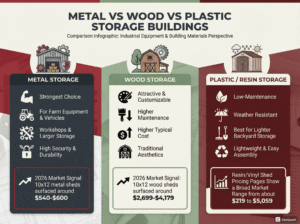
Comparison chart: lifespan, weather resistance, pests, price, and best use case.
Metal vs Wood vs Plastic: Which Is Better?
| Material | Best For | Pros | Cons | Current Price Signals |
|---|---|---|---|---|
| Metal | Farm equipment, tools, larger storage, workshops, vehicle shelter | Strong frame options, better weather resistance, low maintenance, pest resistant, scalable to larger sizes | Assembly can be harder, condensation needs managing, some lighter kits are less robust than they look | 10×12 examples at Home Depot surfaced around $539.99 for a Sizzim 10×12 metal shed and about $600 for an Arrow Classic 10×12; large 25×33 models ranged from $4,941 at KoreJet to $12,569.63 at Home Depot. Source Source Source Source |
| Wood | Backyard aesthetics, custom finishing, traditional residential look | Attractive appearance, easier to modify, strong shelves and interiors | More maintenance, rot risk, repainting/staining, pest exposure, usually higher cost | 10×12 wood shed examples on Home Depot search results surfaced around $2,699, $2,713, and $4,179. Source |
| Plastic / Resin | Low-maintenance home storage, garden tools, casual backyard use | Low upkeep, weather resistant, easy cleaning, often easier assembly | Less suitable for heavy-duty equipment storage, usually less structural strength than larger steel buildings | Lowe’s currently states vinyl/resin sheds typically range from about $219 to $5,059. A Home Depot 10×12 resin example also surfaced in search results at roughly $4.50/sq. ft. with a prior list price of $599.99. Source Source |
Latest 2026 Metal Storage Building Prices
Current 2026 pricing shows just how wide the market range is. Smaller retail metal sheds are still available under $1,000, while larger enclosed farm and garage-style buildings can move well into the five-figure range depending on frame strength, shipping, doors, and weather-rating requirements. Source
| Seller / Model | Size | Current Price | Notes |
|---|---|---|---|
| KoreJet Metal Heavy-Duty Storage Shed | 25 ft x 33 ft | $4,941.00 | Original price listed as $8,784.00; free shipping and 10–15 business day delivery shown on page. |
| KoreJet Metal Barn | 20 ft x 40 ft | $17,681.00 | Original price listed as $22,000.00; page describes 14-gauge galvanized steel framing and 26-gauge panels. |
| Home Depot Oyezvary Metal Shed | 25 ft x 33 ft | $12,569.63 | Home Depot listing for 825 sq. ft. model; product page describes 15-gauge frame and two 8 ft. garage doors. |
| Alan’s Factory Outlet metal building guide | General market guide | $8.20–$12.50 per sq. ft. for open-sided buildings | Source notes fully enclosed structures are typically about double the cost of open-sided models. |
These prices are not direct apples-to-apples comparisons. Enclosure level, roof style, steel gauge, shipping, installation, wind rating, and local code requirements can all shift the final number significantly. Alan’s Factory Outlet notes that code requirements, roof style, customization, and thicker steel all change final cost, and that enclosed buildings often cost much more than basic open-sided structures. Source
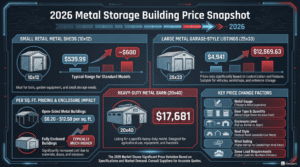
“2026 Metal Storage Building Price Snapshot”
Common Mistakes Buyers Make
The most common mistake is buying based on square footage alone. A building can look large on paper but still feel cramped if the door openings are too narrow, the sidewalls are too low, or the floor plan does not leave room to move around equipment. Another mistake is ignoring climate and code. Wind and snow requirements vary by location, and that can make a major difference in whether a structure is actually suitable for your property. Source
Climate and Maintenance Considerations
For open farmland and rural sites, wind exposure is usually a bigger issue than buyers expect. In snow-prone regions, roof load becomes a top priority. In humid climates, corrosion prevention, drainage, and ventilation matter more. The American Galvanizers Association advises that dirt and mud can generally be removed from galvanized steel with water, and a nylon brush may be used if needed. It also says stronger acids such as hydrochloric, sulfuric, or muriatic acid should not be used because they can damage the galvanized coating. Source
Simple maintenance checklist
- Wash mud and buildup off lower wall areas
- Inspect roof panels and fasteners after storms
- Keep water draining away from the base
- Check hinges, latches, and door tracks regularly
- Inspect for scratches or coating damage and repair as needed
Final Recommendation
If you want durable, flexible storage for farm and home use, a metal building is usually the strongest all-around choice. The featured 25FT x 33FT KoreJet Metal storage shed is a good example of what to look for: solid floor area, a heavier-duty visible steel frame, practical access, and a design positioned for vehicles, equipment, and workshop storage. Buyers who need more capacity can also review KoreJet’s 20FT x 40FT heavy-duty metal barn as a larger next-step option. Source
FAQs
Is metal better than wood for outdoor storage?
For heavy-duty storage, low maintenance, and weather resistance, metal is often the better long-term choice. Wood can look more traditional, but it generally requires more upkeep and usually costs more in comparable 10×12 examples. Source Source
Are plastic sheds worth it?
Plastic and resin sheds are good for low-maintenance backyard storage, but they are usually not the first choice for tractor storage, workshop use, or larger equipment shelter. Lowe’s highlights low maintenance and weather resistance as major benefits of resin sheds. Source
What should I verify before buying a metal storage building?
Verify the exact door opening sizes, wind and snow rating, steel gauge, foundation requirements, and whether engineering documents are available for your location. Source